



















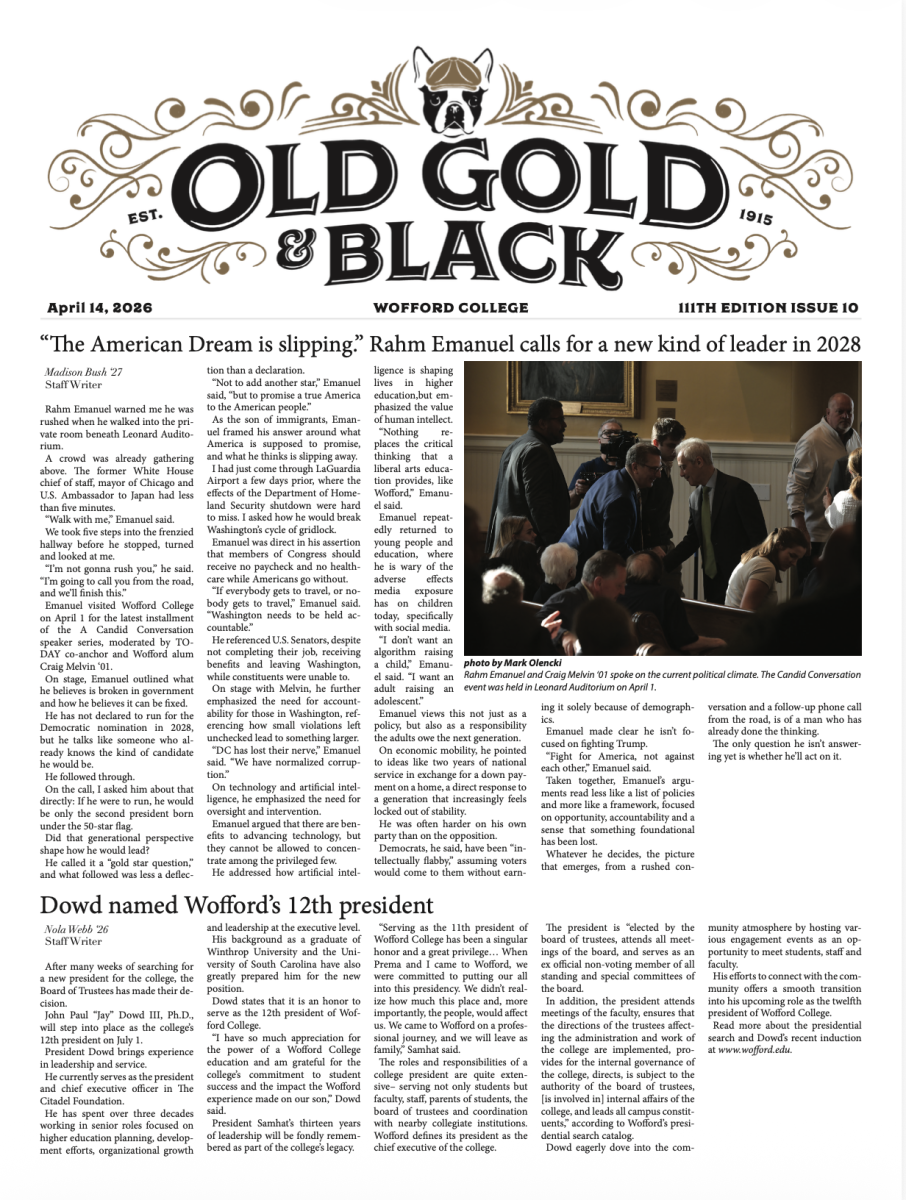
Rahm Emanuel warned me he was rushed when he walked into the private room beneath Leonard Auditorium. A crowd was already gathering above. The former White House chief of staff, mayor of Chicago and U.S. Ambassador to Japan had less than five minutes.
“Walk with me,” Emanuel said.
We took five steps into the frenzied hallway before he stopped, turned, and looked at me.
“I’m not gonna rush you,” he said. “I’m going to call you from the road, and we’ll finish this.”
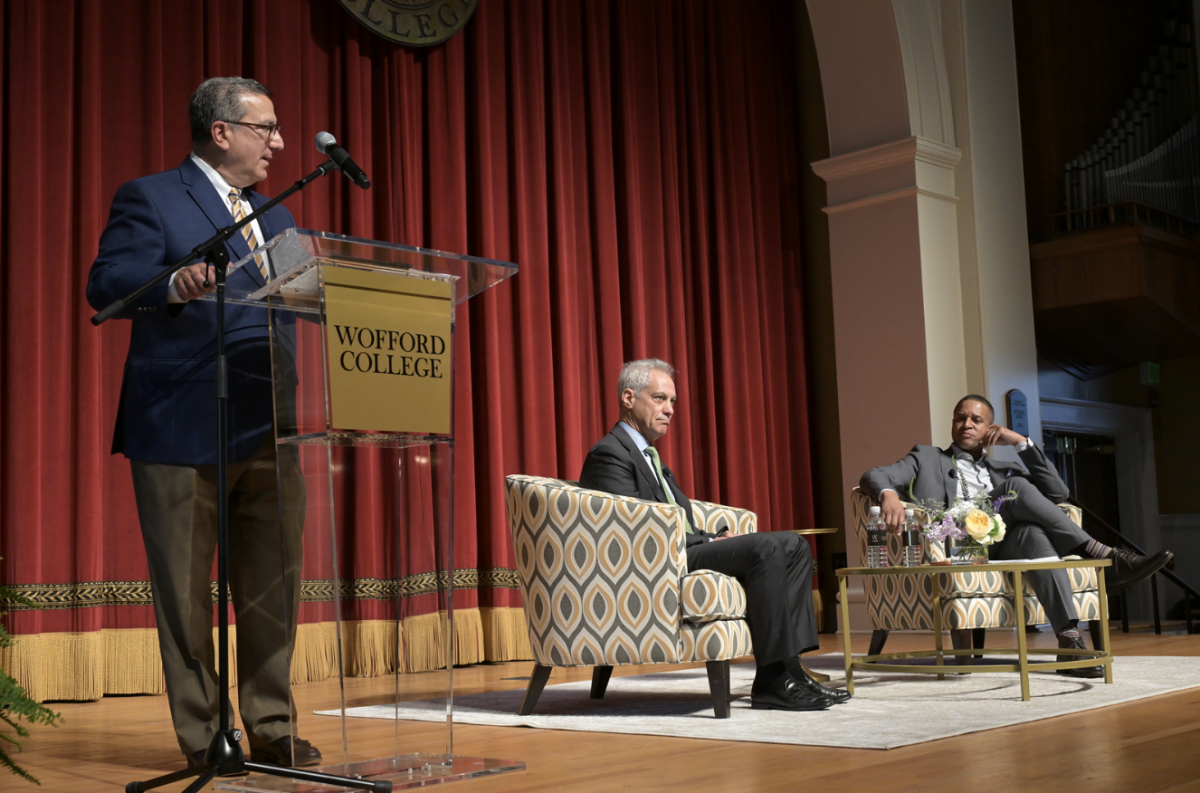
Emanuel visited Wofford College on April 1st for the latest installment of the A Candid Conversation speaker series, moderated by TODAY co-anchor and Wofford alum Craig Melvin ‘01. On stage, he outlined what he believes is broken in government and how he believes it can be fixed. He has not declared to be running for the Democratic nomination in 2028, but he talks like someone who already knows the kind of candidate he would be.
He followed through. On the call, I asked him about that directly. If he were to run, he would be only the second president born under the 50-star flag. Did that generational perspective shape how he would lead? He called it a “gold star question,” and what followed was less a deflection than a declaration.
“Not to add another star,” Emanuel said, “but to promise a true America to the American people.”
As the son of immigrants, Emanuel framed his answer around what America is supposed to promise, and what he thinks is slipping away.
I had just come through LaGuardia Airport a few days prior, where the effects of the DHS shutdown were hard to miss. I asked how he would break Washington’s cycle of gridlock. Emanuel was direct in his assertion that members of Congress should receive no paycheck and no healthcare while Americans go without.
“If everybody gets to travel, or nobody gets to travel,” Emanuel said. “Washington needs to be held accountable.”
He referenced U.S. Senators, despite not completing their job, receiving benefits and leaving Washington, while constituents were unable to. On stage with Melvin, he further emphasized the need for accountability for those in Washington, referencing how small violations left unchecked lead to something larger.
“DC has lost their nerve,” Emanuel said. “We have normalized corruption.”
On technology and artificial intelligence, he emphasized the need for oversight and intervention. Emanuel argued that there are benefits to advancing technology, but they cannot be allowed to concentrate among the privileged few. He addressed how artificial intelligence is shaping lives in higher education, but emphasized the value of human intellect.
“Nothing replaces the critical thinking that a liberal arts education provides, like Wofford,” Emanuel said.
Emanuel repeatedly returned to young people and education, where he is wary of the adverse effects media exposure has on children today, specifically with social media.
“I don’t want an algorithm raising a child,” Emanuel said. “I want an adult raising an adolescent.”
Emanuel views this not just as a policy, but also as a responsibility the adults owe the next generation. On economic mobility, he pointed to ideas like two years of national service in exchange for a down payment on a home, a direct response to a generation that increasingly feels locked out of stability.
He was often harder on his own party than on the opposition. Democrats, he said, have been “intellectually flabby,” assuming voters would come to them without earning it solely because of demographics. Emanuel made clear he isn’t focused on fighting Trump.
“Fight for America, not against each other,” Emanuel said.
Taken together, Emanuel’s arguments read less like a list of policies and more like a framework, focused on opportunity, accountability and a sense that something foundational has been lost.
Whatever he decides, the picture that emerges, from a rushed conversation and a follow-up phone call from the road, is of a man who has already done the thinking. The only question he isn’t answering yet is whether he’ll act on it.