












The widespread public scrutiny of the event ticketing website Ticketmaster continues to gather steam, yet the public is left with little choice when purchasing retail value event tickets. Ticketmaster controls nearly every aspect of the live music experience, from venues to promotions to the ticketing itself, fostering a profit-oriented monopoly.
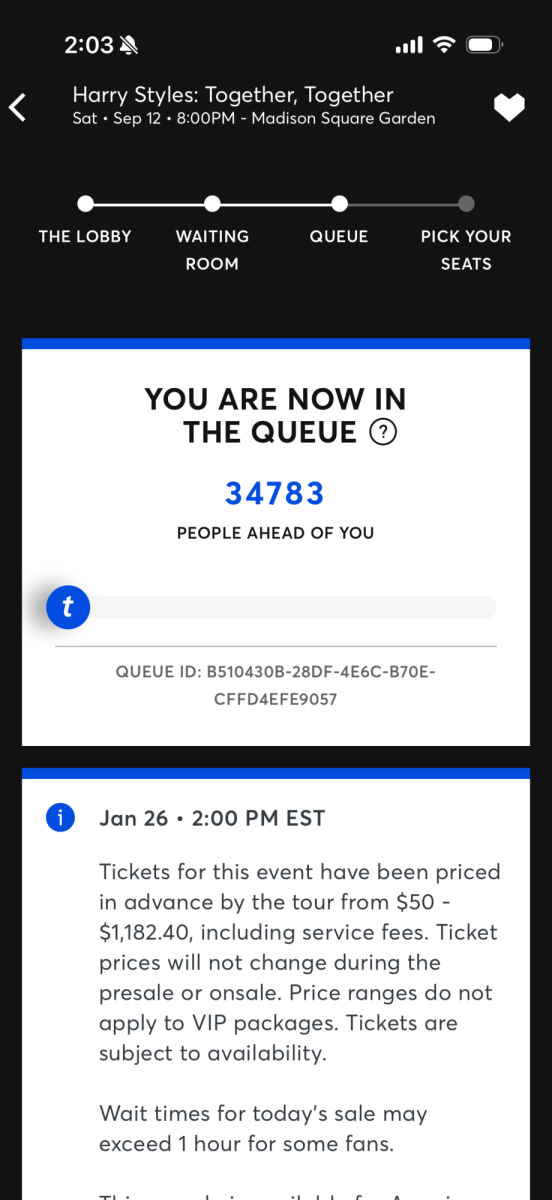
I spent the last weeks of January and into February attempting to purchase tickets to one of 30 different Harry Styles shows at Madison Square Garden in New York. Purchasing tickets is no longer about what dates work best or if the price is just, which it’s not, but it’s now a chance game for a possibility of viewing the available tickets.
There are a slew of reasons for the mayhem of attaining tickets to sports events, concerts, and shows in the year of our lord, 2026. Compared to 30 years ago, the digitization of music has made it more attainable for everyone, meaning more people enjoy a certain artist, thus more people would want to see them in person. Additionally, the use of digital media to advertise live events means it is not just those most attentive to certain artists trying to get tickets, but also the general public, including resellers. This leads to an absurd amount of people trying to get tickets and generating traffic to Ticketmaster.
With this in mind, Ticketmaster’s recent controversies over the chaos of attaining tickets were for tours by artists such as Taylor Swift and Ariana Grande. Not only did Ticketmaster crash due to the traffic, but few fans were able to reach the presale while tickets were still available. Additionally, if they made it through the queue while seats were still available, the ticket prices made tickets virtually unattainable. This is to say, the difficulty in acquiring tickets to some of the most popular artists is not solely because they are in such high demand.
For example, with 11.5 million people registered for Harry Styles New York residency, many fans found themselves behind hundreds of thousands of people despite being in the queue the moment it opened. Although the few face value tickets did consist of the minimum $50, the majority of people were met with tickets between $700-$1,100 or more, due to dynamic pricing.
Dynamic pricing is one of the ways Ticketmaster and Live Nation are able to make such a large profit. While the sale for tickets is active, the price of tickets increases with the demand for the tickets. Additionally, with the 2010 merger of Live Nation and Ticketmaster, all venues owned and operated by Live Nation are required to use Ticketmaster. Venues are able to add 25-30% to the ticket price under the guise of service fees.
Due to this merger between Ticketmaster and Live Nation, there are very few live events that use websites other than Ticketmaster to sell their seats. The idea that venues don’t all need an independent service to purchase tickets simplifies the process for venues and artists. However, Live Nation’s contracts with the majority of major venues mean those venues have to use Ticketmaster. Thus, if artists want to perform at these major venues, then they must also use Ticketmaster. The monopoly the company has on the industry is so vast that no other company can compete.
My parents introduced me to the magic of live music from a young age, so it remains a priority in my life. I will say, I have in the past been blessed by Ticketmaster, when I got two tickets to “Harry Styles’ One Night Only in New York,” in which each ticket was $25. In contrast with that being one show, I entered the presale queue for his upcoming residency 10 different times. My place varied from hundreds of thousands to the smallest, 14,654. By the time I got through the queue, dynamic pricing was already applied to the available seats.
In an age where virtually all everyday actions can be digitized, live events act as a place of connectivity for young people. However, with these manipulations in ticket pricing, concert prices have increased four times faster than inflation in the past thirty years. Where once live music was attainable for young audiences, it is increasingly becoming inaccessible to the demographic it is meant to inspire.